


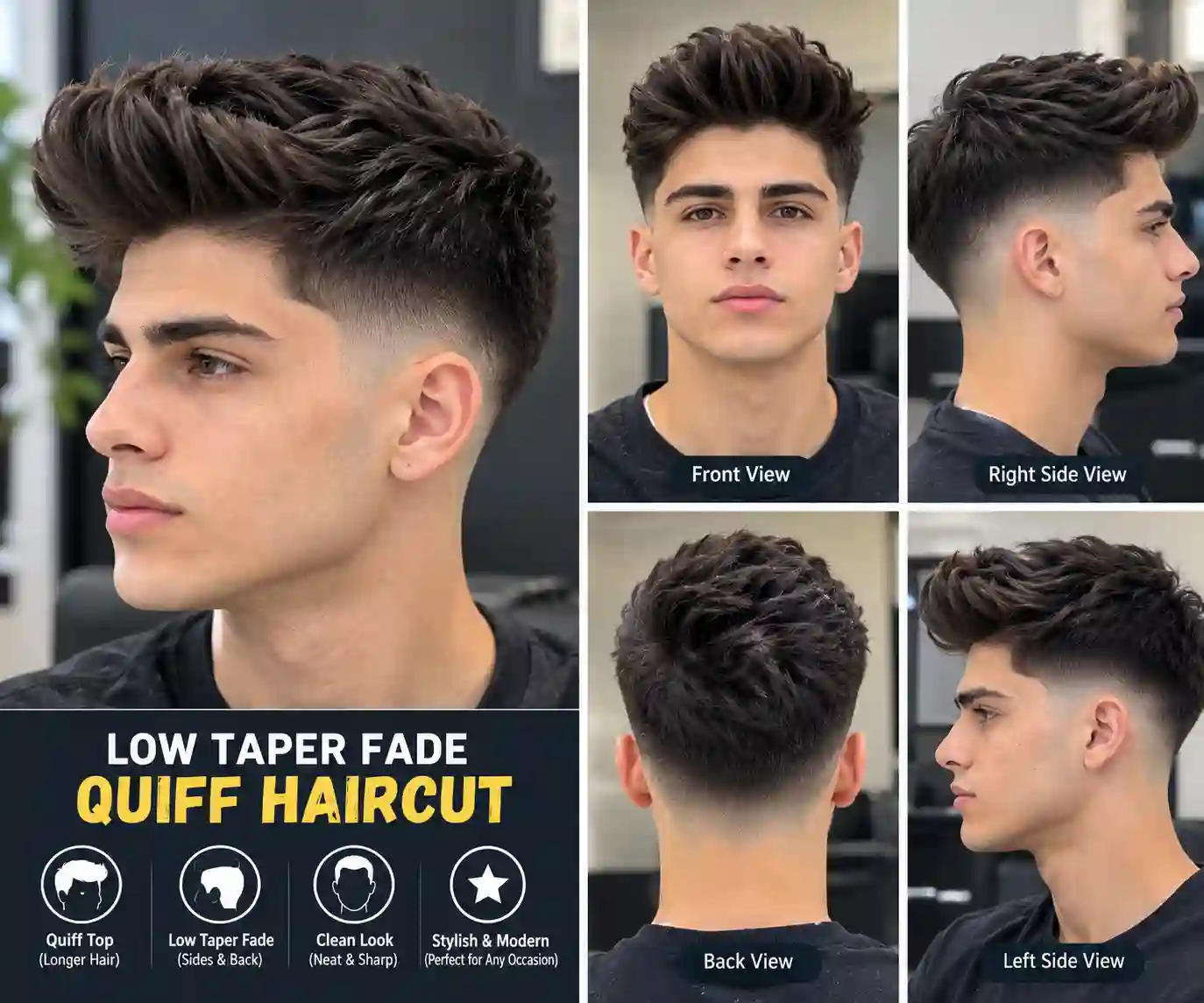
The low taper fade quiff haircut is one of the most versatile cuts a man can wear. It pairs short, neat sides that gently shorten toward the ears and neckline with a longer, lifted top that is brushed up and back. The result looks sharp enough for the office, relaxed enough for the weekend, and works on almost every hair type.
If you are looking for a low taper fade quiff haircut for men, this guide explains what the cut is, who it suits, the best variations, exactly what to tell your barber, and how to style and maintain it at home.
What Is a Low Taper Fade Quiff Haircut?
This haircut combines two classic barbering techniques.
The low taper fade. The sides and back start at a longer length and get gradually shorter as they move down toward the ear and the nape of the neck. Because the fade begins low, only the area around the ears and the bottom of the neckline gets cut tight. The rest of the sides keep some length, which gives a softer, more natural look than a mid or high fade.
The quiff. The top is left longer, usually between 3 and 5 inches at the front, and styled up and back off the forehead. The front sits higher than the crown, giving the cut its signature volume and lift.
Together they create a clean contrast: tidy, close sides and a textured, voluminous top. That balance makes the low taper fade quiff haircut male clients request so often one of the easiest cuts to wear.
The quiff itself blends influences from the pompadour, the brush-up and vintage styles worn by cultural icons such as James Dean, Elvis Presley and David Beckham. The low taper fade version is its modern, softer take.

Taper vs. Fade: What’s the Difference?
If you are wondering what is a taper fade haircut, it is a cut where the hair gets gradually shorter toward the ears and neckline. People often use the two words interchangeably, but they are not identical. A taper leaves the hair slightly longer at its shortest point and follows the natural hairline, so the change in length is subtle. A fade can go down to the skin (a skin or zero fade) and creates a more dramatic blend. A low taper fade sits in between: a gradual, conservative blend that starts low on the head.
Low Taper vs. Mid and High Fades
- Low taper fade: begins just above the ears and neckline. Subtle, professional, easy to grow out.
- Mid fade: begins around the temples. Bolder and more contrast.
- High fade: begins high on the head. Very sharp and high-maintenance.
Two other fade types come up often at the barbershop, and each is a good example of fade haircut variety. A zero fade, also called a skin fade, blends all the way down to bare skin, so it looks the sharpest but needs the most upkeep. A half fade stops partway up the sides and leaves the upper sides longer; exact definitions vary a little from barber to barber. A low taper fade is gentler than both: it only shortens the hair around the ears and neckline.
If you want a polished look without a stark, shaved-sides appearance, the low taper is the safest and most flattering choice, which is why a low fade taper haircut for men is such a common request.
A Quick Guide to Other Types of Fades
Once you know the low taper, it helps to recognize the other fades you will see on a barber’s reference photos.
- Skin (zero) fade: blends all the way down to bare skin.
- Drop fade: the fade line curves downward behind the ear instead of running straight across.
- Burst fade: the fade curves around the ear in a semicircle, while the hair at the back stays longer.
- Taper fade: a gradual change in length that follows your natural hairline.
- Mid and high fades: the blend starts higher on the head, with more contrast.
Any of these can be paired with a quiff, but the low taper is the easiest to wear and to grow out.
Quiff vs Pompadour vs Undercut vs Brush-Up
These four styles are often confused. The main differences are the length on top and how the sides are cut.
| Style | Top | Sides | Overall Look |
| Quiff | About 3 to 5 inches, swept up and back, often textured | Tapered or faded | Casual to smart |
| Pompadour | Longer and taller, smooth and sculpted | Usually short or faded | Polished, vintage |
| Undercut | Long on top, styled any way | Very short, with a sudden jump in length | Bold contrast |
| Brush-up | Shorter than a quiff, brushed upward | Tapered | Neat and low effort |
A low taper fade quiff keeps a gradual blend on the sides, while an undercut has an abrupt step between the top and the sides. That is why the low taper version looks softer and more professional.
Why Men Love This Haircut
- It looks good in any setting. Slick it back for formal occasions or tousle it for a casual look.
- It’s versatile. It works on straight, wavy, and curly hair.
- It grows out gracefully. Because the taper is low and subtle, it doesn’t look messy after a few weeks.
- It adds height and balance. The lifted top can make a round or short face look longer.
- Styling is quick. A few minutes with a blow dryer and product is usually enough.

Who Does the Low Taper Fade Quiff Suit?
Face shape and hair type both affect how this cut sits on you, whether you go for a taper fade with quiff male styling or a more conservative finish.
Face Shapes
- Oval: Almost any quiff works. This face shape carries volume and sharp sides easily.
- Round: The height on top elongates the face. Keep the sides tight and add volume at the front.
- Square: A textured, slightly softer quiff balances strong jawlines.
- Oblong: Go for a lower, less tall quiff so you don’t add too much length.
- Heart: A side-swept, medium-height quiff balances a wider forehead.
Hair Types
Low taper fade quiff haircut for straight hair. Straight hair holds a clean shape but can fall flat. Use a texturizing product and blow-dry upward to build lasting volume.
Low taper fade quiff for wavy hair. Wavy hair is ideal because it already has natural body. A light product enhances the movement.
Low taper fade quiff haircut for curly hair. Curls create a full, textured quiff with real volume. Keep the top long enough for the curls to form, and the low taper keeps the sides crisp against the curls.
Thin or fine hair. Ask your barber for layers on top and use a volumizing powder or sea salt spray to add thickness.
Thick hair. Thick hair may need thinning or texturizing so the top doesn’t become bulky.
Thick, dark, straight hair. This hair type is common across South Asia, including Pakistan, and it holds a quiff well but can feel heavy. Ask your barber to texturize the top, keep it around 3 to 4 inches, and blow-dry it firmly upward. A clay or wax gives the hold you need, especially in warm, humid weather.
Low Taper Fade Quiff for Thinning Hair and Receding Hairlines
A quiff can work well if your hair is thinning, as long as you shape it with care. Keep the top moderately long and heavily textured so it looks fuller, and choose a low taper rather than a tight skin fade, since very short sides make thin areas on top stand out more.
If your temples are receding, sweep the front up and slightly forward instead of straight back, so it softens the hairline. Style with a matte product or texture powder, and avoid slick-back versions and hard parts, which show the hairline clearly. A shorter quiff of about 2 to 3 inches is also easier to keep looking dense.
Is the Low Taper Fade Quiff Right for Your Age?
This cut works across age groups, but small adjustments help.
- Teens and early twenties: you can go longer and messier on top. If you are in school, check the dress code before asking for a high-volume quiff.
- Late twenties and thirties: a textured quiff of about 3 to 4 inches looks sharp at work and casual outside it.
- Forties and beyond: keep the top a little shorter and softer, and use a matte product. The subtle low taper also tidies up greying or thinning sides without looking forced.
Popular Low Taper Fade Quiff Styles
1. Classic Low Taper Quiff
A clean, smooth top swept up and back with a medium-hold product and a neat low taper on the sides. This is the timeless version of the low taper quiff haircut.
2. Textured Quiff with Low Taper Fade
Cut with choppy layers and styled with clay or paste for a rough, matte, lived-in finish. It’s one of the most requested versions because it looks effortless. A textured quiff taper fade works on almost every hair type, and a textured quiff low taper fade keeps the sides softer than a mid fade. Ask for a low taper fade textured quiff haircut by name and your barber will know to add layers on top.
3. Messy Quiff with Low Taper
A relaxed, tousled top with a clean low taper creates a deliberate contrast between rough and neat. Some barbers call this a taper low fade messy quiff haircut.
4. Curly Quiff with Low Taper Fade
Natural curls styled upward and forward, with a gentle low taper keeping the sides sharp.
5. Slick Back Quiff
Styled with a high-shine pomade for a polished, retro look. Best for formal events.
6. Side-Swept Quiff
The top is swept slightly to one side, ideal if you have a natural part or a cowlick.
7. Low Taper Quiff with Beard
A low taper blends neatly into a trimmed beard, creating a seamless transition from hair to facial hair.
8. Low Taper Quiff with Hard Part
A shaved line adds definition and a more sculpted, modern appearance.
9. Short Quiff
A shorter top (around 2 to 3 inches) is easier to maintain and ideal if your hair is thin or your job requires a conservative style.
10. Long Voluminous Quiff
Longer hair on top gives a dramatic, high-volume style that needs more product and more daily effort.

Mid Taper, High Fade and Skin Fade Quiffs: How They Differ
The quiff on top stays the same, but the fade height changes the whole mood of the cut.
Mid taper fade quiff. The blend starts around the temples, so you get more contrast than a low taper while still looking clean. It suits men who want a sharper line without going to skin.
High fade quiff. The sides are very short up to a high point on the head. It is striking and modern, but it needs frequent trims to stay crisp.
Skin fade quiff. The sides go down to bare skin, which gives the boldest contrast against the volume on top. It is high maintenance, and the grow-out phase looks more obvious than with a low taper.
If you like the quiff but want something subtle and easy to maintain, the low taper is still the safest choice.
Other Quiff Variations Worth Knowing
Barbers and style guides use many names for quiff variations. Most of them are small changes to the top, the fade or the styling, so any of them can be paired with a low taper.
- Soft quiff: a gentle lift at the front that bends back, instead of a tall, sharp shape.
- Medium-length quiff: a layered top that looks full and moves easily.
- Forward quiff: the top is pushed ahead rather than back, for a fuller, slightly messy look.
- Loose quiff: a casual, airy version with natural movement.
- Layered quiff: layers on top for extra volume and texture.
- Side part quiff: a defined part with a lifted, voluminous top.
- French crop quiff: a short, cropped fringe with a textured top.
- Spiky quiff: a bold, high-energy version with tousled, lifted spikes.
- Drop fade and burst fade quiffs: the same quiff with the fade curved behind or around the ear.
- Quiff mullet: a quiff at the front with a layered, subtle mullet shape at the back.
How to Ask Your Barber for a Low Taper Fade Quiff
Barbers work from clear instructions and reference photos. Here is what to say.
- Bring a photo. A picture of a low taper fade quiff on someone with similar hair is the most reliable way to avoid misunderstandings.
- Specify the fade. Say: “A low taper fade on the sides and back, starting just above the ears.”
- Choose the shortest length. Tell your barber whether you want it blended down to the skin or kept slightly longer (for example, a number 1 or 2 guard).
- Describe the top. Say: “Leave 3 to 4 inches on top, textured, styled up and back.”
- Discuss the neckline. Choose between a natural, tapered, or squared neckline.
- Ask for styling advice. A good barber will show you which products and technique suit your hair.
Barber Terms to Know Before You Sit Down
A few words make the conversation with your barber much easier.
- Guard number: the clipper attachment that sets how long the hair stays, with lower numbers cutting shorter.
- Blend: the smooth transition between two lengths, with no visible line.
- Neckline: the shape at the back of your neck, which can be natural, tapered, rounded or squared.
- Edge-up (lineup): sharp lines cut around the forehead and temples.
- Texturizing: cutting that removes bulk and adds movement on top.
- Point cutting: snipping into the ends of the hair for a choppy, lived-in finish.
- Weight line: the visible point where the longer top meets the shorter sides.
Getting a Low Taper Fade Quiff at a Barber in Pakistan
If you want a low taper fade in Pakistan, keep in mind that barbers may use different names for the same cut, such as “taper cut”, “low fade” or simply “side se halka”. To avoid a cut that is shorter or higher than you wanted, be specific.
- Show a photo, even if it is only a screenshot on your phone.
- Say it in plain words: “neeche se halka fade, kaanon ke upar tak, upar se 3 se 4 inch lamba rakhna.”
- Name the fade height. Say “low” clearly, because some barbers default to a mid or high fade.
- Ask for scissor work on top, not only the machine, so the quiff keeps its shape and texture.
- Check the mirror early. Ask the barber to pause once the sides are done, before the top is cut.
- Plan for the weather. In summer heat and humidity, a matte clay with a light hairspray holds better than heavy pomade.
Low Taper Fade Quiff for Weddings and Groom Hairstyles
A low taper fade quiff is a popular choice for grooms and wedding guests because it looks neat in photos and is easy to keep in place through a long day. Many weddings in Pakistan have several events, such as the mehndi, barat and walima, so plan the haircut around them.
- Do a trial cut a few weeks before. This lets you fix anything you do not like in time.
- Get the final haircut a few days before the first event. The cut settles, and the fade does not look freshly shaved.
- Book a quick neckline tidy for the day before. It keeps the edges sharp without changing the shape.
- Choose a strong hold for long days. Clay or wax, plus a light hairspray, keeps the volume up in heat and crowds.
- Carry a small comb. A quick touch-up helps before photos.
How to Cut a Low Taper Fade Quiff at Home with a Trimmer
If you want to follow a low taper fade tutorial with trimmer at home, start cautiously. You can always cut more, but you cannot put hair back. Many men find it easier to get the first cut from a barber and then maintain the neckline and ears at home.
What You Need
- A clipper or trimmer with guards (common guard sizes are about 3, 6, 10 and 13 mm, but they differ between brands)
- A comb, scissors and a hand mirror
- A small edging trimmer for the neckline
When choosing a clipper or trimmer for fades, look for adjustable or interchangeable guards, a sharp blade that does not pull the hair, and a comfortable grip. A cordless model is easier to move around the head, while a corded one does not lose power mid-cut. You do not need an expensive set to start, but a poor-quality clipper makes blending much harder.
Step-by-Step Tutorial
- Start with dry, combed hair. Comb the top upward so the length you want to keep stays out of the way.
- Use the longest guard first. With the 13 mm guard, run the clipper upward over the sides and back, stopping where the head curves toward the top.
- Step down on the lower sides. Switch to the 10 mm guard and work the lower half of that area, stopping about 2 cm above the ears.
- Tighten around the ears and nape. Use the 6 mm guard only around the ears and the bottom of the neck.
- Blend the lines. Flick the clipper away from the head at the end of each stroke so there are no hard lines between lengths.
- Clean up the neckline. Use the edging trimmer lightly, following your natural hairline.
- Cut the top with scissors. Leave about 3 to 4 inches at the front and point-cut the ends for texture.
- Check from every angle. Use the hand mirror and fix any uneven spots before you style.
If the blend looks patchy, stop and let a barber correct it rather than going shorter.
How to Style a Low Taper Fade Quiff at Home
What You’ll Need
- A towel
- A blow dryer
- A round or vent brush (optional)
- Styling product: clay, paste, pomade, wax, or sea salt spray
- A comb
Step-by-Step Guide
- Start with damp hair. Towel-dry your hair so it’s damp, not soaking wet.
- Apply a pre-styler. A sea salt spray or volumizing mousse gives grip and lift.
- Blow-dry upward. Direct the airflow up and back from the front hairline while brushing or combing the hair in that direction. Use medium heat.
- Use a small amount of product. Warm a pea-sized amount between your palms. Use more only if needed, since too much weighs the quiff down.
- Work it through. Run your fingers from the front to the back, lifting the hair up at the front.
- Shape the quiff. Use a comb or your fingers to define the shape and tidy the sides.
- Finish with light hairspray. This locks in volume and keeps the style intact through the day.
Choosing the Right Product

| Finish | Best Product | Best For |
| Matte, natural | Clay or paste | Textured and messy quiffs |
| Glossy, polished | Pomade | Classic and slick back quiffs |
| Light, flexible | Cream or wax | Short quiffs and fine hair |
| Extra volume | Sea salt spray or powder | Thin or flat hair |
You do not need a specific brand. Choose by the hold level and finish printed on the label, and pick a water-based product if you want it to wash out easily. Thick hair usually needs a stronger hold, while fine hair does better with something light. If you are unsure, start with a small tub and see how it behaves through a full day.
The best hair products for a quiff are the ones that match your hair and the finish you want. A simple kit is enough: a pre-styler such as sea salt spray, one main styler like clay or paste, a light hairspray, and a clarifying shampoo to remove buildup now and then.
Each product type does a slightly different job:
- Texture clay: strong, matte hold with definition, ideal for textured and messy quiffs.
- Molding paste: medium, flexible hold with a soft, touchable finish.
- Styling cream: light control that smooths flyaways and gives a subtle shine.
- Texture powder: instant root lift for weightless volume.
- Pomade: firm hold and shine for slick, polished quiffs.
- Sea salt spray: natural texture and a casual, airy finish before blow-drying.
- Argan oil: a few drops can smooth dry ends and reduce frizz on longer tops.
- Hairspray: a light mist at the end locks the shape in place.
How to Maintain Your Low Taper Fade Quiff
- Trim every 3 to 4 weeks. Fades lose definition quickly. A regular visit keeps the taper crisp.
- Wash with a quality shampoo. Avoid washing every day if your hair is dry, and use conditioner to keep the top healthy.
- Avoid product buildup. Rinse thoroughly and use a clarifying shampoo occasionally.
- Protect from heat. If you blow-dry daily, use a heat protectant.
- Between cuts, tidy the neckline and around the ears yourself with a trimmer only if you’re confident. Otherwise, leave it to your barber.
How Long It Takes, What It Costs, and How to Grow It Out
Time: A low taper fade quiff usually takes about 30 to 45 minutes at a barber, and 5 to 10 minutes to style each morning once you have the routine.
Cost: Prices depend on your city and the barbershop. A fade is often priced like a standard men’s haircut or slightly higher, so ask before you sit down.
Growing it out: Hair grows roughly half an inch (about 1 cm) a month on average. Because the taper is low and subtle, it blends back into the rest of your hair within about six to eight weeks. While you grow it out, keep the neckline and ears tidy and trim the top every couple of months so the quiff keeps its shape.
Common Mistakes to Avoid
- Cutting the top too short. Without enough length, you can’t create a real quiff.
- Using too much product. Heavy styling flattens volume and makes hair look greasy.
- Skipping the blow dryer. Blow-drying is what creates lift, especially for straight hair.
- Choosing the wrong fade height. If you want a conservative look, don’t ask for a mid or high fade.
- Neglecting regular trims. A grown-out fade looks untidy and loses the contrast that defines this cut.

Frequently Asked Questions
It’s a haircut with short, gradually blended sides that start low near the ears and neckline, combined with a longer top styled upward and back into a quiff.
Aim for roughly 3 to 5 inches on top. Shorter lengths can work for a mini quiff, but you’ll have less volume.
Yes. Curly hair gives the quiff natural volume and texture. Keep the top long enough for your curls to form and let the low taper clean up the sides.
Yes. Because the fade is subtle and the top can be styled neatly, it’s appropriate for offices and formal settings.
Most men book a trim every 3 to 4 weeks to keep the taper sharp.
A quiff is generally shorter, more casual, and swept up and back with a softer shape. A pompadour is bigger, longer, and more sculpted, usually with high shine.
Yes. Ask for layers on top, use volumizing products, and keep the length moderate so the hair looks fuller.
The low taper grows out gently. Keep trimming the neckline and ears while letting the sides and top lengthen so the shape stays neat.
A zero fade blends all the way down to bare skin at its shortest point. It is also called a skin fade, and it looks very sharp but needs trims more often than a low taper.
A half fade shortens the sides and back up to about the middle of the head and leaves the hair above that line longer. Definitions vary slightly between barbers, so bring a photo.
Start with the longest guard, step down to shorter guards near the ears and nape, blend with flicking strokes, and clean up the neckline. The full walkthrough is in the home trimmer section above. If you are new to clippers, let a barber do the first cut.
Final Thoughts
The low taper fade quiff haircut balances classic barbering and modern style. Its subtle fade, textured top, and flexibility across hair types and face shapes make it a dependable choice whether you’re dressing up or keeping it casual. Bring a reference photo, be clear with your barber about fade height and top length, and invest a few minutes in styling. With regular trims and the right product, this cut will keep you looking sharp every day.
